Verified in source
No implementation has been verified.
Distributed Event Delivery & Reliability Infrastructure
Build an observable delivery pipeline with explicit failure handling and a clear contract for duplicates and replay.
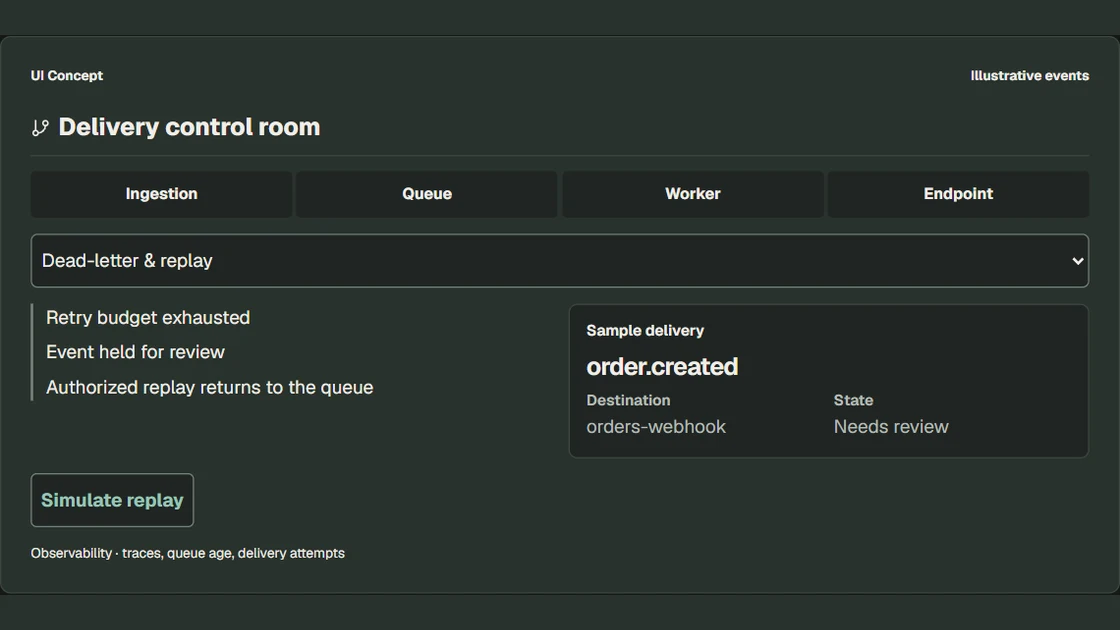
Try the interactive prototype with sample data.
Sample delivery
Observability · traces, queue age, delivery attempts
Webhook consumers fail independently. Producers need a durable way to retry delivery, inspect failures, and replay events safely.
Repository last inspected .
No implementation has been verified.
Java · Spring Boot · Kafka · PostgreSQL · Redis · OpenTelemetry · Prometheus · Grafana · Docker · Kubernetes · AWS
Follow the numbered flow. Expand a node to inspect its responsibility.
Submit a validated event with a stable idempotency key.
Authenticate producers and persist accepted input.
Buffer events and redeliver unacknowledged work.
Sign attempts, record outcomes, and schedule retryable failures.
Verify signatures and deduplicate delivery IDs.
Propose tenant-scoped events, endpoints, attempts, idempotency keys, and replay audit records. Use an outbox to bridge durable writes and queue publication.
Propose event ingestion, endpoint registration, delivery history, and audited replay. Acknowledge ingestion only after durable persistence.
Handle duplicate deliveries, retry storms, slow endpoints, and replay ordering without promising exactly-once delivery.
Scope credentials by tenant, sign payloads with timestamped signatures, restrict outbound endpoint access, and redact payload details in logs.
Partition queues by tenant or endpoint as needed. Bound worker concurrency, cap retry budgets, and monitor queue age.
Plan contract tests, duplicate and replay scenarios, load tests, and fault injection for timeouts, worker loss, and recovery.
Not yet measured.