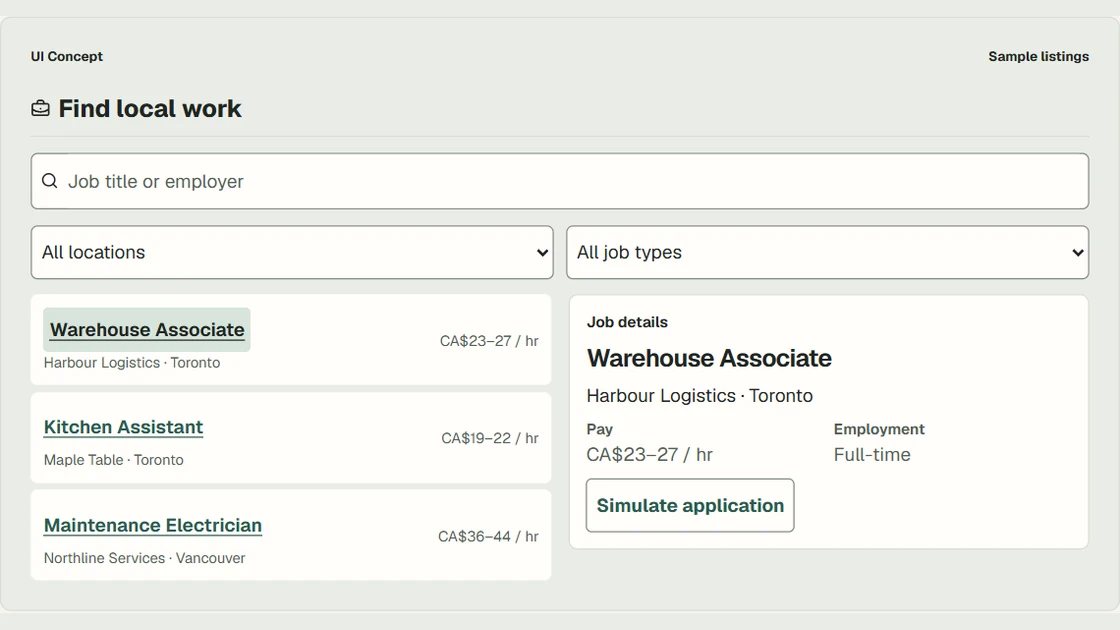
Compare pay and inspect a listing without leaving the results.
Simulate applying and see confirmation for that job.
Problem & target users
Finding legitimate local work is difficult when pay, schedules, and travel distances are hard to compare.
Hourly and shift workers
Skilled trades and local contractors
Small employers in retail, hospitality, logistics, and domestic services
Implementation status
Repository last inspected .
Verified in source
Source for job search, listing detail pages, and read-only job endpoints with pay filters.
Source for worker profiles, employer onboarding, job drafts, and review submission.
Opt-in administrative review source and audit migrations. Runtime integration is still unverified.
Planned features
Radius-based discovery and job matching
Applications, saved jobs, alerts, and real-time messaging
Independent employer verification and fraud prevention
Multilingual search, recommendations, indexing, and distributed notifications
Technologies found in source
Java · Spring Boot · Spring Security · Next.js · TypeScript · PostgreSQL · PostGIS · Docker Compose
Proposed technologies
Redis · Kafka · AWS
System architecture
Proposed architecture
Follow the numbered flow. Expand a node to inspect its responsibility.
Client
Worker discovery and employer workspaces.
API Gateway
Validate requests and enforce request budgets.
Identity Service
Resolve roles and employer memberships.
Job Service
Own draft, review, and publication state.
Search Service
Index approved jobs and rank nearby matches.
Application Service
Track applications and hiring decisions.
Notification Service
Send asynchronous updates and alerts.
The current source uses a Spring Boot modular monolith.
Database design
Current migrations cover listings, identities, memberships, verification, and review audit history. A proposed application table would use job and worker keys and enforce a unique application constraint.
API architecture
Current source includes public discovery and role-gated employer and worker endpoints. Planned application and alert endpoints would use scoped authorization and idempotent writes.
Engineering challenges
Compare compatible pay periods and currencies, balance distance and relevance, and keep unpublished listings outside discovery.
Security considerations
Validate provider assurance before enabling privileged review. Test tenant isolation and redact worker contact data from public responses.
Scalability strategy
Use geospatial and filtered indexes, bounded pagination, and asynchronous indexing and notification delivery when load warrants it.
Testing strategy
Repository test source covers discovery, filters, roles, review and lifecycle. Run full application and PostGIS integration suites before treating these workflows as operational.
Roadmap & technical evidence
Verify local builds, database integration, and CI
Complete authenticated hiring and pilot trust workflows
Evaluate geospatial search and matching with consented data